15 Bath Hotels Built by the Woods, a General and a Hospital Board
Two houses in the middle of the Royal Crescent, a hospital with 17,500 Roman coins under its floor and thermal water in its spa, four townhouses built for a marquis, and a Palladian estate with a mile-long avenue.
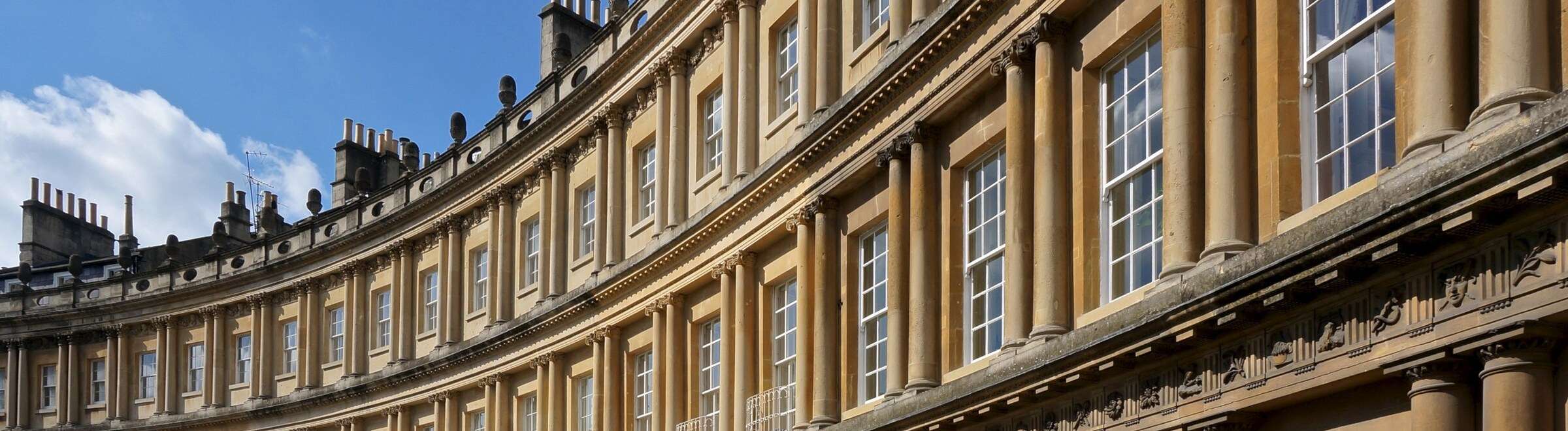
Bath’s hotels are the houses John Wood and his son built, and a few the Victorians added on the hills. This list has the Royal Crescent Hotel in the two central houses of the Crescent, the Gainsborough in the 1826 Bath United Hospital, where a hoard of Roman coins turned up in 2007, the Queensberry in four townhouses the younger Wood built for a marquis, and the Francis on Queen Square, rebuilt at one end after the 1942 Baedeker raid.
The list is grouped by character, not ranked. Where a hotel’s own site could be confirmed, its name links there; the rest are listed without one.
Grand dames and landmark houses
The Royal Crescent Hotel & Spa · Royal Crescent / Upper Town
The Royal Crescent Hotel occupies Nos 15 and 16, the two central houses of the Royal Crescent, built between 1767 and 1775 to John Wood the Younger’s design. It has traded as a hotel since 1971, with an acre of garden and the Dower House restaurant hidden behind the Grade I terrace. Frederick, Duke of York, son of George III, is listed among the past residents of No. 16, by the hotel’s account.
The Gainsborough Bath Spa · City centre / Abbey (Beau Street)
The Gainsborough occupies the former Bath United Hospital of 1824 to 1826, designed by John Pinch the Elder and later used as Bath Technical College. The Beau Street Hoard of around 17,500 Roman coins was unearthed on the site in 2007 during archaeological work ahead of the conversion. YTL Hotels opened it in 2015 and bills its Spa Village as the only hotel spa in the UK fed by Bath’s natural thermal water.
The Bath Priory · Weston / Royal Victoria Park
The Bath Priory was built in 1835 as a private Gothic-style house in Bath stone on Weston Road, and stands in four acres of mature gardens a short walk from Royal Victoria Park. Andrew Brownsword Hotels, the group behind Gidleigh Park, has run it since 1994.
Macdonald Bath Spa Hotel · Bathwick / Sydney Gardens
The Bath Spa Hotel was built in 1835 as Vellore House for General Augustus Andrews, who named it after the Indian fort town where he had served. A Grade II listed temple and grotto survive in the grounds beside Sydney Gardens. It served as a nurses’ home for the Royal United Hospital before reopening as a hotel in 1990, by the hotel’s account.
Francis Hotel Bath · Queen Square
The Francis occupies a run of houses on the south side of Queen Square, the first set piece John Wood the Elder built in Bath from 1728. Emily Francis began taking lodgers at No. 6 in 1884, by the hotel’s account, and the business spread house by house along the terrace. The east end was destroyed in the Baedeker raid of April 1942 and rebuilt after the war.
Georgian townhouse hotels
The Queensberry Hotel · Upper Town / The Circus (Russel Street)
The Queensberry is four townhouses on Russel Street built in 1771 and 1772 by John Wood the Younger, a few doors from the Circus. They were built for the Marquis of Queensberry, which gives the hotel its name. The Olive Tree restaurant in the vaults holds a Michelin star.
Hotel Indigo Bath · City centre / South Parade
The Indigo occupies houses on South Parade, the terrace John Wood the Elder laid out in the 1740s overlooking the Avon. It opened in September 2020 after IHG combined the former Halcyon hotel with neighbouring buildings. Walter Scott was brought to South Parade as a boy in 1775 to take the waters for his lameness, by the hotel’s account.
No.15 by GuestHouse, Bath · Great Pulteney Street / Bathwick
No.15 stands on Great Pulteney Street, laid out in 1789 by Thomas Baldwin for Sir William Pulteney as the grand approach from Pulteney Bridge. Ian and Christa Taylor opened it as No.15 Great Pulteney and sold it to GuestHouse in 2021. The spa is set in the vaults beneath the house.
Abbey Hotel Bath, a Tribute Portfolio Hotel · City centre / Abbey (North Parade)
The Abbey Hotel is three Georgian townhouses on North Parade, John Wood the Elder’s 1740s terrace facing Parade Gardens. Ian and Christa Taylor relaunched it in 2012 as the first of what became their Kaleidoscope Collection and sold it on in 2021; Castleforge later bought it, and it now trades under Marriott’s Tribute Portfolio flag.
Harington’s Hotel · City centre / Queen Street
Harington’s is three listed houses, Nos 8 to 10 Queen Street, on a cobbled lane that predates Bath’s Georgian rebuilding, by the hotel’s account. It is named after Sir John Harington of nearby Kelston, Elizabeth I’s godson and the inventor of the flushing water closet.
Victorian villas with a story
The Roseate Villa Bath · Bathwick / Henrietta Park
The Roseate Villa is a Victorian villa overlooking Henrietta Park, run for years as the Villa Magdala before Roseate Hotels took it on. The old name recalled the 1868 Magdala campaign in Abyssinia, a Victorian habit of naming houses after imperial victories. Henrietta Park opposite opened in 1897 to mark Queen Victoria’s Diamond Jubilee.
Apsley House Hotel · Newbridge / Weston (west of the centre)
Apsley House is a Georgian house on Newbridge Hill dating from about 1830, by the hotel’s account. The hotel says the house was built for the Duke of Wellington and takes its name from his London home at Hyde Park Corner.
Country houses outside the city
Lucknam Park Hotel & Spa · outside Bath (Colerne, Wiltshire)
Lucknam Park is a Palladian country house of 1720 at Colerne, six miles from Bath, approached by a mile-long avenue of beech and lime trees across a 500-acre estate, by the hotel’s account. It opened as a hotel in 1988 and now carries Accor’s Emblems Collection badge.
Bailbrook House Hotel · London Road / Batheaston edge of Bath
Bailbrook House was built in the 1790s to a design by John Eveleigh, the architect of Camden Crescent and Somerset Place. Hand Picked Hotels restored and reopened it in 2013 after years as a nurses’ home and conference centre, by the hotel’s account. It stands in twenty acres on the hillside above the London Road, three miles from the centre.
The Pig near Bath · outside Bath (Hunstrete, Pensford)
The Pig near Bath is Hunstrete House, an eighteenth-century country house in the Chew Valley eight miles south-west of the city. It opened as the fourth Pig in 2014 after a long run as the Hunstrete House Hotel, and keeps a deer park and a walled kitchen garden that supplies the restaurant.
Frequently Asked Questions
Are these hotels ranked?
No. The groups sort them by character, and the order within each group carries no meaning.
What made a hotel interesting enough for this list?
A story. Every entry was a landmark house with a documented past, a Georgian townhouse with a name attached, a Victorian villa with a reason for its name, or a country house with a history outside the city. Comfort alone did not qualify.
Why are there no prices?
Rates change daily and a priced list goes stale in a month. Where a hotel runs its own site, its name links there, so you see the current rate and book direct.
Should I stay in the centre or up by the Crescent?
The centre puts you beside the Abbey, the Roman Baths and the station, on streets that fill with day-trippers until late afternoon. The Upper Town around the Circus and the Crescent is a ten-minute climb, quieter and closer to the Georgian set pieces. The country houses are a taxi ride out and a different trip.
Which hotel puts me closest to the day trips on this site?
Most day trips from Bath run to Stonehenge and Avebury, to the Cotswolds, to Wells and Glastonbury, or to Lacock and Castle Combe. The hotels in the centre near the station sit closest to the coach pickups.